
Choosing the right CRM can be tricky, especially with Podium, Zoho and HubSpot all claiming to be the answer. Here's what separates them, and how to tell which one fits what your business needs.
Quick answer: Podium is built for review generation and fast customer messaging, best suited to local trade and service businesses. Zoho is a low-cost, highly configurable generalist that covers CRM and more but needs setup work to perform well. HubSpot is built as a single system connecting marketing, sales and reporting, and is the strongest option once a business needs to know which leads are worth chasing and which marketing spend is paying off.
What each tool is for
Podium was built for local and trade businesses running on reviews and fast replies. Its whole job is turning phone calls, texts, Google reviews and Facebook messages into one inbox your team can work from. If you run a plumbing business or a dental clinic and your biggest headache is beating a competitor to the callback, Podium does that job properly.
Zoho is the budget generalist. CRM, email, invoicing, a dozen other modules, all under one roof that’s a bit clunky to move around in. Cheap, flexible, and it’ll do almost anything if you’re willing to spend the hours configuring it.
HubSpot is built to be the system of record for how a business grows. Every contact, every deal, every email, every website visit, tied together with reporting that shows you what’s working.
Comparison at a glance
|
Podium |
Zoho |
HubSpot |
|
|---|---|---|---|
|
Best for |
Reviews & fast messaging |
Budget-conscious generalists |
Businesses scaling marketing + sales together |
|
Core strength |
Unified inbox for calls/texts/reviews |
Low cost, highly configurable |
Marketing-sales-reporting all connected |
|
Setup effort |
Low |
High (lots of configuration) |
Moderate (guided implementation) |
|
Sales pipeline tracking |
Basic |
Yes, with setup |
Yes, native |
|
Marketing attribution |
No |
Limited |
Yes |
|
Typical business size |
Single location, trade/service |
SME, cost-sensitive |
Scaling SME to mid-market |
|
Where it hits a ceiling |
No real pipeline or attribution |
Reporting gets messy without heavy config |
Overkill only if you never plan to grow past a shared inbox |
The pattern we see over and over
Almost every business we talk to didn’t choose Podium or Zoho because they thought it through. They chose it because it was the tool they could set up in an afternoon, or the one a mate recommended, or the cheapest option when they were three staff, and everything ran through one person’s inbox.
That’s a fine decision at the time. It stops being fine once the business grows and nobody notices the system hasn’t grown with it.
Here’s what that looks like on the ground. A lead calls in, gets a text reply through Podium, books a job. Six months later, someone in the office wants to know how many of last quarter’s paid ad leads turned into paying customers. Nobody can answer that. The reply happened. The booking happened. None of it connects back to where the lead came from or what happened after.
Or sales is tracked in someone’s head, or a spreadsheet that’s a version behind, or a Zoho pipeline nobody trusts because half the deals in it are stale. The owner asks what’s in the pipeline this month and gets a shrug instead of a number.
Or marketing spend keeps climbing and nobody can say which campaign, which channel, or which piece of content is behind the last ten sales. So the budget conversation every quarter is a guess dressed up as a decision.
None of this is Podium or Zoho failing at their job. They’re doing exactly what they were built to do. The problem is what they were never built to do: connect a marketing dollar spent to a sale closed.
Before and after
|
Before (Podium / Zoho / spreadsheet) |
After (HubSpot) |
|
|---|---|---|
|
Lead response |
Fast reply, no record of source |
Fast reply, source and campaign tracked automatically |
|
Pipeline visibility |
“I think we’ve got a few in the works” |
Live view of every deal, stage, and value |
|
Reporting |
Manual, pieced together before meetings |
Dashboard updates in real time |
|
Marketing attribution |
Can’t be answered with confidence |
Traced from first click to closed deal |
|
Team handoffs |
Verbal, easy to lose detail |
Logged against the contact automatically |
|
Growth ceiling |
Hit fast once volume increases |
Built to scale with the business |
How to decide
Business owners tend to compare CRMs on price and feature lists, but that's not the ideal starting point. The real question is what decision you need this data to help you make in six months. Ask yourself these questions:
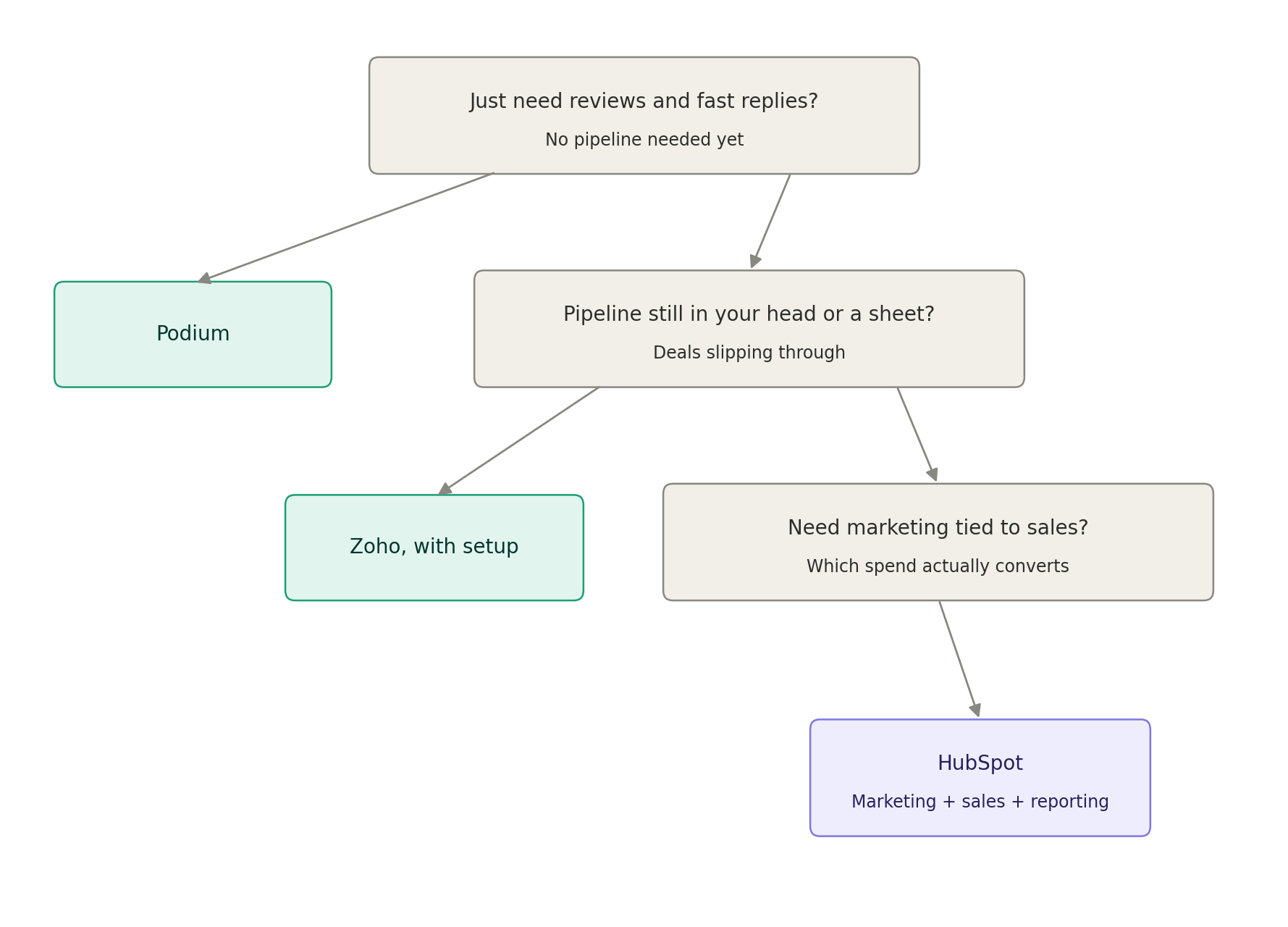
Do you need a CRM, or do you need reviews and fast messaging? If your problem is purely responding quickly and getting more Google reviews, you might not need a CRM yet at all. Podium’s built for exactly that.
Is your sales process still “remember and call back”? If your pipeline lives in someone’s head or a spreadsheet and things are already slipping, that’s where a proper CRM starts earning its keep. Zoho can get you there with effort. HubSpot’s built for it from day one.
Do marketing and sales need to talk to each other? This is where HubSpot separates itself from the other two. If you want to know that the blog post someone read in March is the reason they signed in July, marketing and sales need to be sitting on the same data. That link wasn’t the design priority for either Podium or Zoho.
Decision flow
Summing Up
There’s no single right answer for every business. A one-location trade business with five staff and strong word of mouth might genuinely be fine on Podium for another year or two.
But a business past that stage, running paid ads, email, or a longer sales cycle, tends to hit the ceiling fast, usually right around the point where nobody can say which marketing spend is working. Once that question starts costing you real budget decisions, HubSpot is the one built to answer it.
Want a second opinion before you commit to a platform? Book a free consultation with our team of HubSpot specialists.